The problems owners tell us about
Nine complaints. Nine answers. Real screens for each.
We read the reviews, the pricing pages and the fine print for the software sold to barn makers, manufacturers and dealerships, and we listened in our own yard. These are the nine things that come up again and again, and what a custom build does about each one.
No vendor is named as guilty of any of these. They are patterns across the trade, and some of the platforms handle some of them well. The point is what we do differently.
Most screens on this page are from the full Barnwright software, which isn’t for sale yet. Ready today: the 3D Designer and Dealer Center, $0 setup and $250 a month.
Complaint one
“The bill grows every time we do.”
Per-user seats. Per-module add-ons. Support that only really works on the expensive plan. And in this trade specifically, a monthly service fee that climbs with your sales: one leading platform charges $300 a month at under $500K in sales, $1,550 at $3M, and over $2,000 at $5M.
What we do: one monthly figure, fixed in your quote, for every screen and every person. Add a driver, a dealer, a painter or a second shop and it does not move. Sell twice as much next year and it does not move.
What a Barnwright monthly fee covers
- Every screen in your build, for everyone who works for you
- Hosting, nightly backups, and fixes
- The person who built it, on the phone
- No per-user fee. No fee tied to your sales. No tiers.
$250 a month for the 3D designer and Dealer Center. The full software or a custom version is coming soon at $500. No build fee.

One sheet. The designer, the quote and the invoice all read this box.
Complaint two
“The 3D designer is a second company and a second bill.”
Most shed platforms do not make their own designer. They plug in one from another vendor, and you pay that vendor too: a setup fee in the thousands and a few hundred a month, priced by your sales. Then two programs from two companies have to agree on your prices, and they never quite do.
What we do: the 3D designer, the price sheet, the quote and the invoice are one piece of software from one maker. Change a price once, in one place, and all four say the new number the same second. It is the one thing two companies cannot promise you.
Complaint three
“We’re locked in.”
Multi-year contracts. A fee to release your own customer records if you cancel. Integrations you would have to rebuild from scratch to leave. Owners call it vendor lock-in, and it is why so many stay on software they dislike.
What we do: your software runs on accounts in your name, not ours. Every night it writes a backup you can download. If our servers went dark, your software would keep working exactly as it was, and it never sends us your customers, your orders or your money. There is nothing to release, because we never held it.
Built into every Barnwright copy
Daily automatic backup. Your records are backed up every night and you can download the file any time.
Fails open. If the licence server is unreachable, the software keeps running as it was. Nothing locks you out.
Your accounts. The database, the hosting and the card processor are set up in your name. You hold the keys.

The shop’s board. Built for the way a shop actually decides what to do next.
Complaint four
“We had to change how we work to fit the software.”
The general tools — the CRMs, the field-service apps, the construction managers — are built for the average business. As one review put it, they “don’t speak shed”. So you end up with a spreadsheet on the side, a whiteboard in the shop, and a person whose job is retyping.
What we do: we start from how you work today. The shop board above puts the buildings nobody has picked up on top, because those are the only ones anybody has to do something about. That is not a setting; it is how the shop thinks. The software fits the process. The process does not bend to the software.
Complaint five
“It’s too complicated. We need training.”
Reviews of all-in-one platforms come back to the same word: complex. Menus for everything, because the software has to do everything for everyone. Owners talk about training budgets and the one person on staff who knows where things are.
What we do: each person gets one screen for their job and nothing else. The painter’s phone shows the next building, three colors and a button. The driver’s phone shows today’s stops and what to collect at the door. Nobody on the line types a price, sees a price, or can get to one — and that is decided on the server, not by hiding a menu.
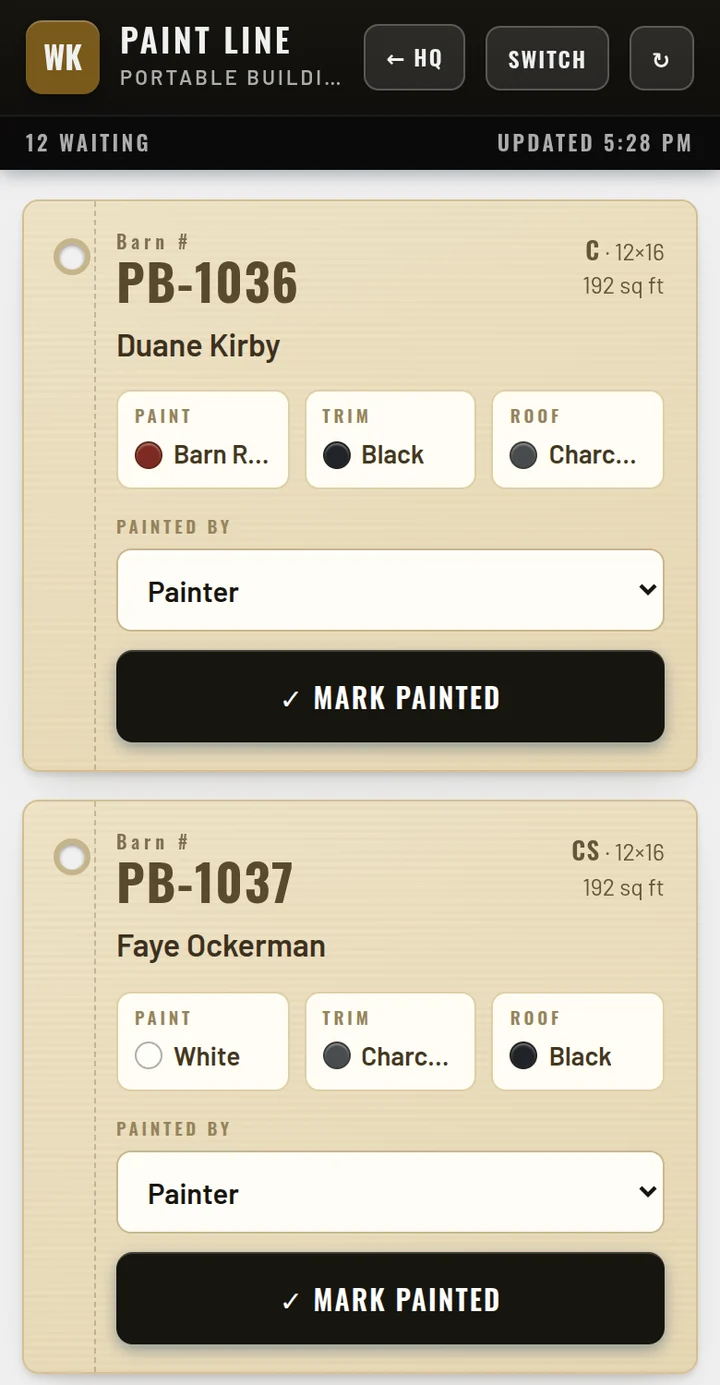 Crew · the painter’s whole screen
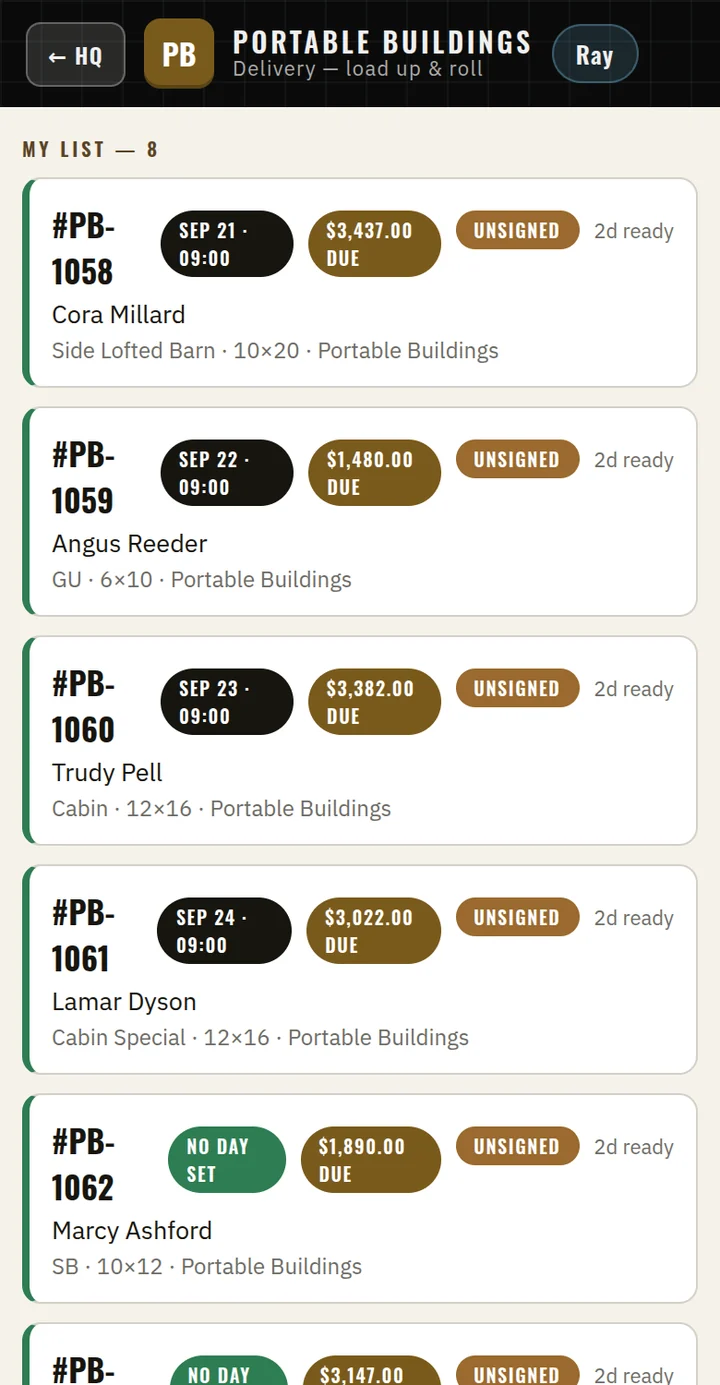 Delivery · the driver’s whole screen
Who you talk to
(574) 214-9617
sales@barnwrightsoftware.com
That number rings the person who built your software and who runs Barnwright at his own shed business every day. Not a ticket queue, not a call center, not a plan tier.
There is one honest limit: one person is one person. A platform has a support department. We say so plainly on the comparison page.
Complaint six
“After the sale, support went to a call center.”
Dealer-software reviews describe it the same way every time: a good salesperson, then a handoff to a general help desk, then after-hours help that costs extra. The people who understand your business are not the people who answer the phone.
What we do: the monthly service is the person who built it staying on the job. When something breaks, it is ours to fix, and the person fixing it knows your build because he wrote it.
Complaint seven
“There’s no signal in the yard.”
Cloud software assumes a connection. A shop at the back of a lot, a crew on a customer’s ground, a driver in the county between towers: the screen spins, and the work stops until somebody walks toward the road.
What we do: the crew, driver, dealer and shop apps install on the phone like any app and keep their last copy. Lose signal and you still have your list, the address, the phone number and the building. The office sees the update when the phone finds a bar again.
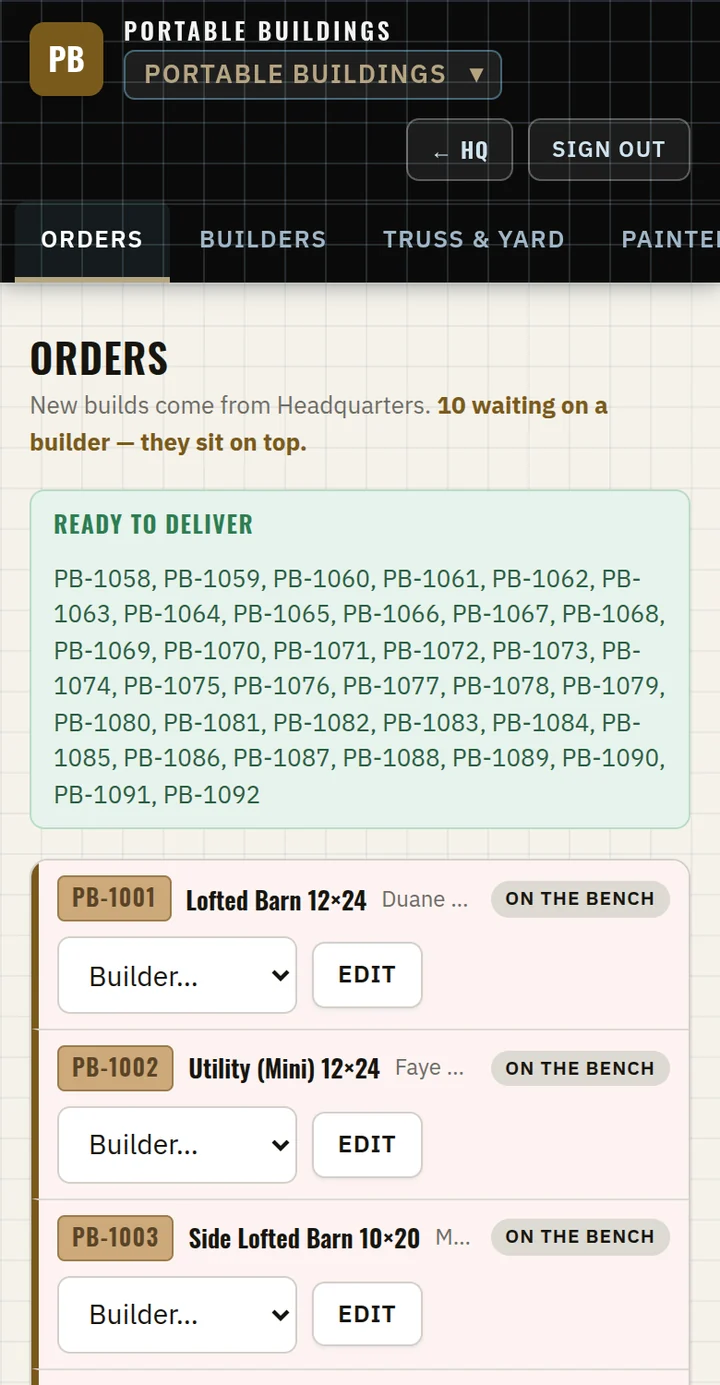 Shop floor · on the phone on the wall
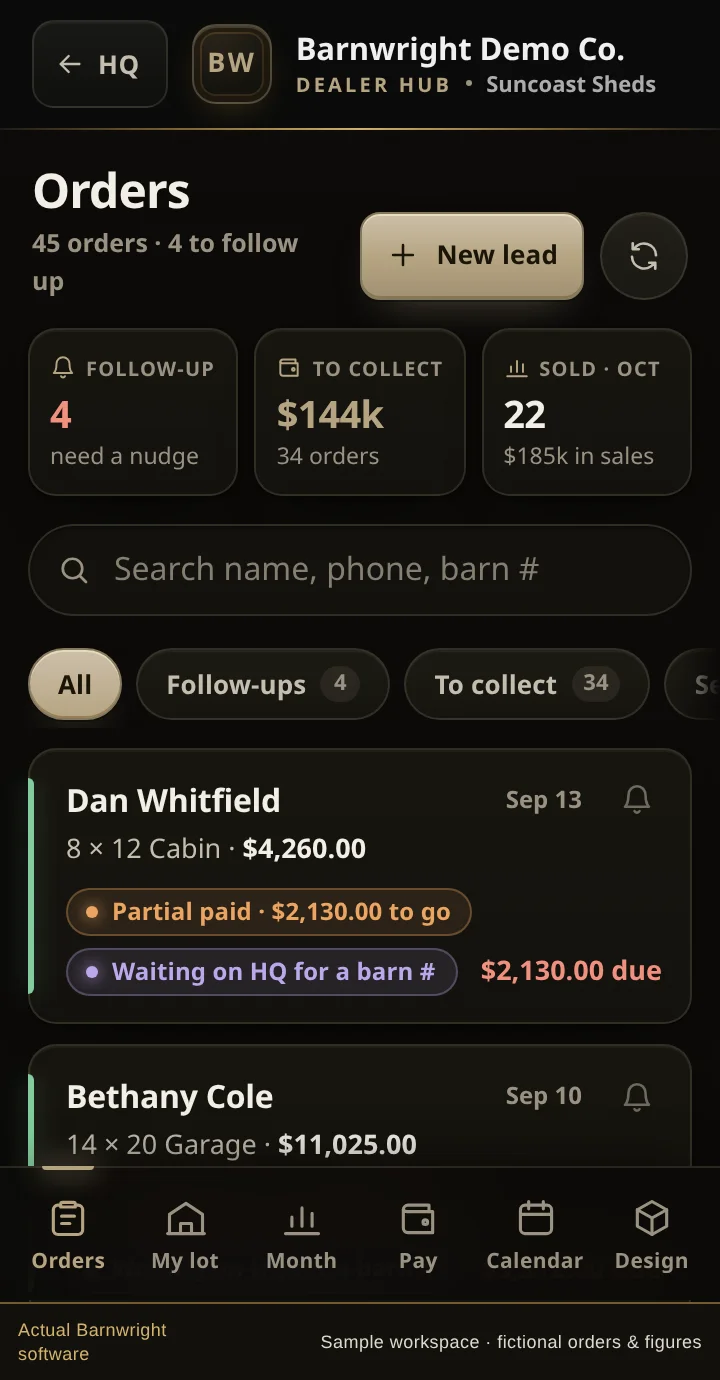 Dealer Hub · works on a lot with no signal
Tell us the idea
A call or the form. Your words, your process, whatever you use today.
We write it down and price it
A plain list of what it will do and a fixed price, agreed before work starts.
You use it as it takes shape
Your buildings, your prices, your people, screen by screen.
One real job, together
Quoted to delivered with us on the phone. Then it runs on its own.
Complaint eight
“Implementation took months.”
The industry’s own advice is blunt: companies doing eight figures struggle to implement business software, and in the best case it takes “a lot of time, effort and money”. Migrations stall, the data comes across wrong, and the old spreadsheet never quite goes away.
What we do: a single-task app is live in weeks. A connected system takes longer, and we tell you how long before you agree to anything. Either way you are using it while it is built, so there is no big-bang switchover day. And we load your price sheet ourselves, checked line by line against what you already quote.
Complaint nine
“Custom software costs a fortune.”
It usually does. A simple internal tool from an agency starts around $15,000 to $25,000; a mid-size system runs $40,000 to $150,000; US developers bill $150 to $250 an hour. That is why most small businesses rent instead.
What we do: we are not starting from nothing. Barnwright already exists and runs every day at a real shed business. A build for you reuses those proven parts — the job record, the shop board, the phones, the designer, the payments — and shapes them to your process. The 3D designer and Dealer Center is $250 a month. Custom versions are coming soon at $500 a month, with no build fee. And if we do custom work for you and you don’t like it, you get your money back.

Already built. Already running. Your build starts from here, not from a blank page.
Which of these is yours?
Tell us the one that costs you the most sleep. We will tell you honestly whether a build fixes it, and what it would cost, before you commit to anything.